
Boulder council to consider downtown authority ballot questions as library seeks protections
The proposed authority could begin collecting revenue in 2027, but library trustees say the plan lacks guaranteed representation, revenue sharing and other financial safeguards.
Published at
Boulder City Council is scheduled to decide Aug. 6 whether voters should be asked in November to create a downtown development authority, approve a 3.67-mill levy and authorize tax-increment financing. Boulder Public Library District trustees are seeking protections before that decision.
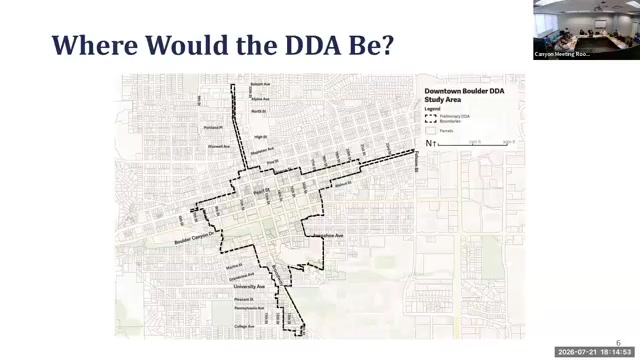
The proposed district would include downtown Boulder, the Civic Area, University Hill and connecting corridors, according to the city’s DDA formation project description. It would consolidate the existing downtown and University Hill parking-focused general improvement districts and use a future development plan and intergovernmental agreements to guide projects and parking assets.
At the library board’s July 21 meeting, consultant Brad Siegel and city staff said the proposed footprint had been reduced by about 10% after some property owners outside the core areas showed limited interest. The narrative description indicated the library and Boulder High could be included, but the record did not include a parcel-level map or final legal boundary.
Presenters said the authority could begin collecting revenue in 2027 if the ballot measures and later approvals succeed. The timing is not automatic: A DDA board would have to be formed, a development plan approved by the board, Planning Commission and City Council, and agreements completed.
The presentation modeled 30-year property-tax outcomes rather than guaranteed collections. Under an assumed 1.5% annual decline, the library district was projected to receive about $41 million; under 1% annual growth, about $56 million. The DDA was projected to capture about $73 million in property-tax increment. Siegel acknowledged the growth assumptions were aggressive for a largely built-out area.
City staff said the library would retain its existing property-tax base and natural appreciation, while the DDA would capture defined future growth from new construction and investment. A draft letter of intent discussed at the meeting would give the DDA all captured sales-tax growth for its first five years, then potentially split growth 75% to the DDA and 25% to the city in years six through 10. The arrangement would be reconsidered after that, and no library-specific revenue-sharing agreement was guaranteed.
Trustees asked for a library-specific intergovernmental agreement, a guaranteed seat or other formal governance role on the DDA, financial neutrality for the library district, priority for capital investments near the library and other civic anchors, and recurring support for library-led activation and programming. They criticized what they described as limited consultation and said protections should be secured before the council vote.
The board did not take a position on the DDA. Trustees agreed to prepare a letter to City Council and consider speaking at the Aug. 6 meeting. City staff said a formal library agreement could not be completed until the DDA exists because it would require two governmental parties. Staff and Siegel said the library might be eligible for a board seat as a property holder or leaseholder, but neither a seat nor revenue sharing was guaranteed.
The council’s Aug. 6 action, final ballot language and parcel-level district boundaries remained unresolved as of July 22.