
Boulder Utilities develops six-year plan with $35 million Barker Dam project in mix
A preliminary 2027-2032 capital and rate package also includes a possible $17 million wastewater-compliance project. Staff expect to present more detail in August, with a September public hearing planned before City Council action.
Published at
Boulder Utilities is developing a 2027-2032 capital and rate package that could include a roughly $35 million Barker Dam project, a possible $17 million wastewater-compliance effort and continued work on aging pipelines, treatment systems and flood infrastructure.
The package remains preliminary. At the July 20 meeting, Utilities staff told the Water Resources Advisory Board that the board would get a more detailed presentation in August. A September meeting is expected to serve as a public hearing, followed by recommendations to City Council. No project or cost discussed July 20 was adopted.
Candidate capital projects
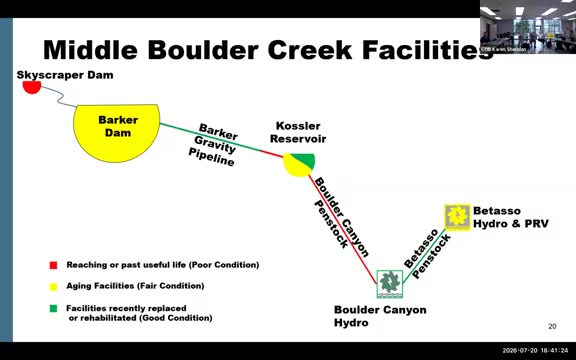
Staff described Barker Dam as the largest single capital item under discussion, with a planning figure of about $35 million. The discussion initially focused on outlet works or valves that control releases, but staff said they were stepping back to evaluate the dam as a whole. The figure is therefore a candidate estimate, not an approved appropriation or final scope.
Other potential water-system work includes rehabilitation of dams and pipelines, treatment-plant systems, and transmission and distribution lines. Boulder’s earlier 2026-2031 Capital Improvement Program planned $59.4 million in Utilities infrastructure spending in 2026, but that program is separate from the 2027-2032 package now being developed.
Wastewater projects under consideration include pipe lining, interceptor improvements and treatment-facility compliance work. Staff discussed a possible compliance project of about $17 million, while saying its regulatory requirements and technical design were still developing. The amount and scope remain uncertain.
Stormwater and flood work could include drainage infrastructure, creek-bank stabilization and flood conveyance. Utilities’ water, wastewater and stormwater/flood services operate through enterprise funds supported primarily by user fees, bonds and grants. Staff said apparent gaps between 2025 revenues and expenses largely reflected multiyear capital-project carryovers and committed funds, rather than an immediate operating shortfall.
The city’s utility-rate explainer says City Council-approved 2026 increases took effect in January: 8% for water, 6% for wastewater and 5% for stormwater/flood. Those increases do not establish the rates staff will recommend for 2027 and later years.
Commercial water-rate study
A separate study is examining two possible ways to charge commercial water accounts. One would use consumption blocks based on meter size, with a higher per-unit price as use increases. The other would retain a water-budget approach but standardize how budgets are calculated, moving some legacy accounts away from individualized historical-use calculations.
Staff said the study was still being revised and that effects would vary by customer. Dedicated irrigation accounts were excluded, and some commercial accounts whose budgets already use objective factors such as fixtures or meter size could see little structural change. Staff did not provide customer counts or bill-by-bill estimates.
The analysis is expected to be completed by the end of 2027, with possible implementation Jan. 1, 2028. Residential outreach was planned for late August, followed by a fall board presentation and a spring presentation to City Council. No commercial-rate change was approved July 20, so the date is a potential implementation target, not a guarantee that any customer’s bill will rise or fall.