
REC sales lowered Longmont’s reported noncarbon share in 2025, packet says
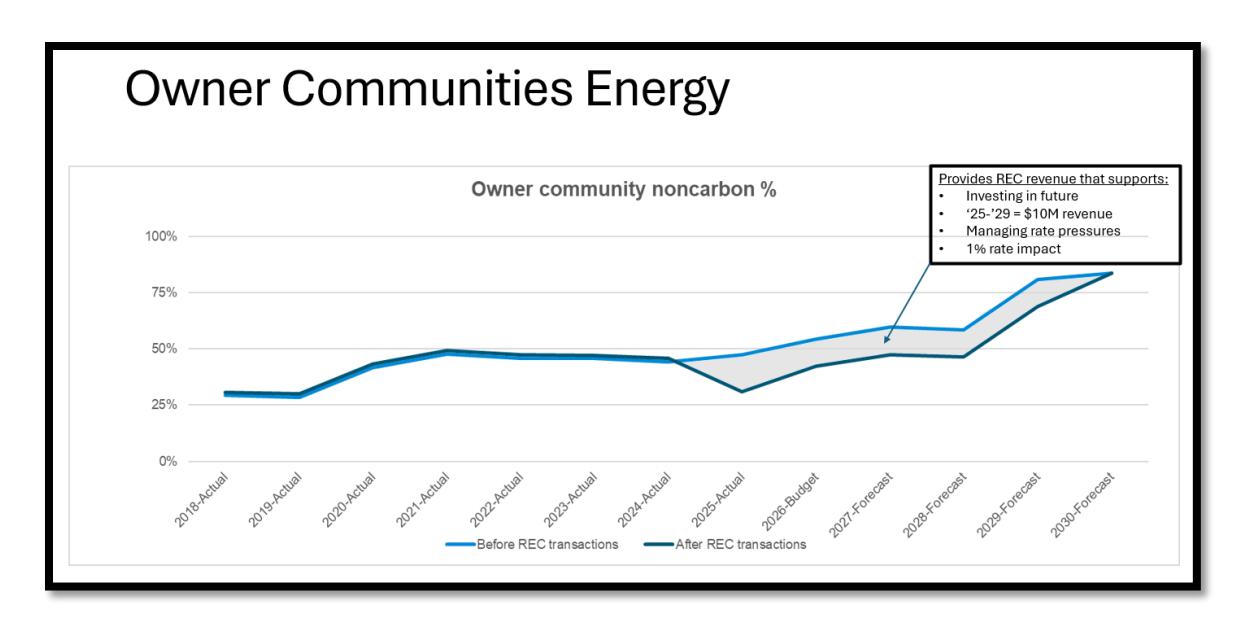
Platte River’s REC sales are expected to generate about $10 million and ease rate pressure, but Longmont’s reported renewable share fell to 31% in 2025 and staff project the city could miss its 2030 emissions target.
Published at
A renewable-energy-credit sale by Platte River Power Authority reduced the share of energy Longmont reported as noncarbon from 46% in 2024 to 31% in 2025, while generating an estimated $10 million intended to ease near-term rate pressure, according to a Longmont Sustainability Advisory Board packet. The packet says the sales are scheduled to continue through 2029.
The sale does not mean Platte River stopped adding renewable resources. But the utility and its owner communities cannot claim the renewable environmental attributes attached to energy and renewable-energy credits sold to another buyer. Platte River’s board materials say the associated generation is therefore unavailable for Platte River and Longmont’s renewable-energy accounting.
The packet describes the financial effect as an estimate: about $10 million in revenue and a “beneficial rate impact value of 1% annually.” That figure is not a 1% reduction in customers’ bills. Platte River rate documents describe surplus-sale revenue as reducing the utility’s revenue requirement or easing rate pressure, without isolating a customer-specific credit from the REC sales.
The broader rate picture points in the opposite direction. Platte River’s 2025 budget projected a 6.3% increase in Longmont’s average wholesale rate, from $72.37 to $76.90 per megawatt-hour. The projection includes multiple factors and is not identified as the net effect of the REC transaction. Longmont’s residential rate page does not attribute its charges or any year-over-year change to REC-sale proceeds.
The accounting change is expected to increase Longmont’s reported greenhouse-gas emissions compared with what they would have been if the sold renewable attributes remained available. The packet says the city and Platte River cannot count the sold REC-associated generation in their inventories for 2025 through 2029. Longmont’s 2024 greenhouse-gas inventory reported that 46% of the city’s electricity came from renewable sources and that total emissions were 16% below the 2016 baseline.
Longmont has a target of reducing emissions 66% from the 2016 baseline by 2030. Staff project a reduction of about 55% to 56% in 2030, even if the city meets its other stated goals, leaving it 10 to 11 percentage points short. The preliminary estimate could change after a model update expected in September 2026 and a more extensive update planned for 2027. The packet says the REC accounting effect is not expected to change the projected emissions impact in 2030 and beyond, when the sold RECs are no longer excluded.