
Boulder recommends $417 million operating budget with service cuts, utility rate increases
The $417.24 million plan includes $6.3 million in reductions; council is scheduled to consider related tax and fee measures Oct. 15.
Published at
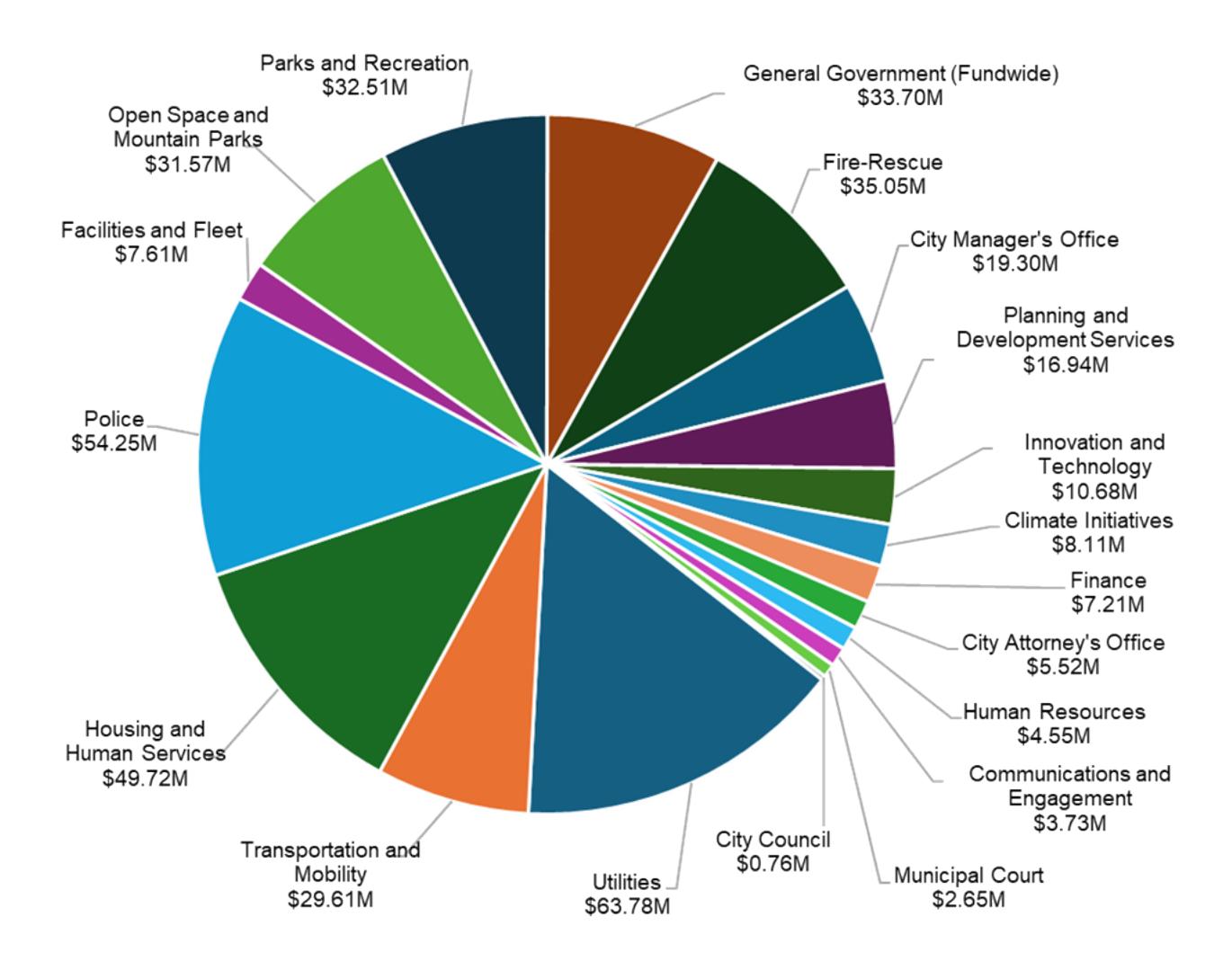
Boulder’s recommended 2027 operating budget would total $417.24 million, 2.35% above the 2026 approved operating budget, and include $6.3 million in reductions. City Council is scheduled to hold a public hearing and consider the budget and related tax and fee measures Oct. 15, the city’s budget memo and draft ordinances and district resolutions show. The citywide recommended budget totals $552.6 million, including $135.36 million for capital projects; the $417.24 million figure is for operating expenses.
Proposed reductions include shorter hours at Scott Carpenter Pool, ending child watch at East Boulder Community Center and reducing ongoing funding for Spruce Pool. One-time funding would keep Spruce Pool open through 2027. The budget memo says the operating plan was balanced after the reductions.
The tax and fee package proposes a 5% increase in water rates and 7% increases in wastewater and stormwater and flood-management rates. Customer bills would depend on use. The proposal would also begin collecting a Transportation Maintenance Fee from property owners in 2027. The budget forecasts $3.03 million from the fee for transportation maintenance, including bridges, pavement, sidewalks and street markings; the packet does not specify a per-property charge.
A draft ordinance would set the city property-tax levy at 11.648 mills: 7.948 mills for general operations, 2 mills for public safety, 0.8 mill for the Community Housing Assistance Program and 0.9 mill for the Permanent Park and Recreation Fund. Separately, the budget memo says the city will raise its recreational-marijuana retail sales-tax rate from 3.5% to 5.5% starting Jan. 1, 2027. It describes that as an administrative change under existing city authority, not an ordinance in this package.
The proposed fee schedule would raise some charges for specific users. The annual rental-license excise tax would rise from $80.71 to $82.57 per dwelling unit, and rental-license fees would increase from $190 to $220 per building or accessory dwelling unit. For new homes, transportation excise taxes would rise from $4,826.22 to $4,951.70 for detached homes and from $3,501.50 to $3,592.54 for attached homes and mobile homes. A $2.48-per-square-foot transportation charge would apply to new or additional nonresidential floor area. The charges apply when the relevant taxable activity or permit is involved.
Among the district proposals, Boulder Junction’s Parking district would cut its levy from 10 mills to 5 mills for 2027 through a temporary tax credit, then return to 10 mills in 2028. Its proposed budget is $357,149. Central Area and University Hill districts would also use temporary credits, resulting in proposed net levies of 4.238 mills and 1.400 mills, respectively. Forest Glen Transit Pass proposes a zero-mill levy for 2027, instead of its standard 2.310 mills.
The Downtown Boulder Business Improvement District’s proposed budget and operating plan estimate a 4.357-mill levy, which the plan says will be finalized in December. The district levy applies to taxable real and personal property that is not agricultural or residential, principally affecting covered downtown businesses and property owners. The Knollwood Metropolitan District proposes keeping its 20.570-mill levy unchanged.