
Boulder staff report fewer shelter turnaways and camping-related access problems
Staff reported year-to-date declines in shelter turnaways and public-space problems, but the available record lacks raw counts and does not establish what caused the changes.
Published at
Boulder staff reported year-to-date declines in shelter turnaways and camping-related access problems in 2026, but the available record does not show the underlying counts or establish what caused the changes.
At an Aug. 24 Parks and Recreation Advisory Board briefing, Housing and Human Services staff reported a 22% decline in people screened through coordinated entry, a 35% increase in housing exits and a 79% reduction in shelter turnaways compared with 2025. The meeting recording does not provide the raw counts, denominators or a complete data table behind those percentages.
The transcript inconsistently describes the comparison period as January through June and January through July. Staff characterized the figures as covering 2026 so far, not a completed calendar year.
Coordinated entry is the initial screening used to assess a person’s needs and connect them with shelter and services. The city describes it as the “front door” to the regional homelessness system for single adults experiencing homelessness, according to its homelessness-services guidance.
Staff member Megan Newton said about 60% of people screened reported that their current episode of homelessness began outside Boulder, including about 30% who were from out of state. She said that proportion had remained roughly stable for three years.
Newton said a housing exit means that someone in the community helped a person move into housing. The regional system generally groups exits into categories such as diversion, reunification, treatment, long-term programs, housing and other outcomes. The record does not show how many exits produced the reported 35% increase.
The transcript also does not define “shelter turnaway” or provide the number of people turned away in either comparison period. The 79% figure therefore can be reported only as a staff-reported percentage, not as a count of people served or turned away.
Newton said Boulder adopted its homelessness strategy in August 2025 and began implementing it in January 2026. She said the city funds providers, coordinates partnerships and sets direction rather than directly providing most homelessness services. The strategy includes shelter, day services, navigation, medical respite, diversion, reunification, financial assistance, outreach and housing-related services.
Newton said she could not determine how much of the improvement was caused by the strategy. She pointed to expanded shelter and housing activity in Denver, Aurora and the Tri-Cities as a possible factor. “I would imagine folks having other places to go, they have not ventured up here would be my guess, but I don’t know,” she said.
Public-space problems also declined
Joanna Bloom, the city’s Utilities deputy director for policy and planning, said the Safe and Managed Public Spaces program has operated since 2021. She reported declines in community camping reports, a 36% reduction in debris collected from encampments between 2024 and 2025, and a 54% decline in encampments causing access problems at buildings or along multi-use paths.
Bloom emphasized that community reports do not correspond one-for-one with the number of camps. The meeting record provides no raw totals for reports, debris or access-problem encampments.
She attributed the trends partly to faster responses and said more people may be following behavioral expectations. She also said Urban Rangers “do play an important role,” but no analysis quantified the effect of rangers, signs or any particular service.
The city’s SAMPS program description says the operation combines outreach, cleanup, space maintenance, data and safety support. Its goals include connecting people experiencing homelessness to services and keeping public spaces and infrastructure accessible.
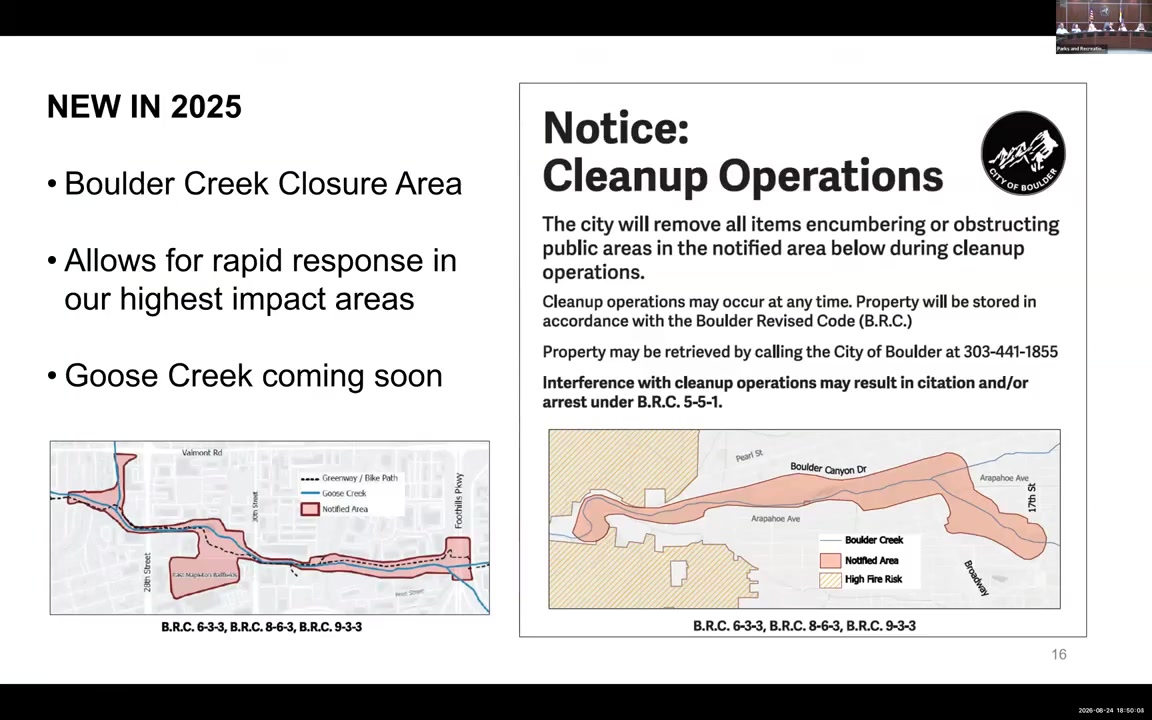
The program installed permanent signs along about one mile of Boulder Creek near the end of 2025. Staff anticipated similar signs along Goose Creek near the Mapleton fields, which they described as another camping hotspot. No official city record located for this report confirms that those signs have since been installed or specifies their wording or an enforcement schedule.
Bloom told board members the signs would provide standing notice and make expectations clearer but would not eliminate required notice periods. The city’s public-spaces management policy generally provides 72 hours’ notice before an unsanctioned-camping cleanup, with limited exceptions for dangerous obstructions on multiuse paths and in underpasses.
The city says its ranger program has three permanent and three seasonal limited-commission officers. Parks and Recreation Director Ali Rhodes said rangers focus primarily on education and outreach and enforce conduct rules, not homelessness itself.
The reported metrics show changes in Boulder’s operations, but the available record does not establish their scale in raw numbers or explain why they occurred. Staff cautioned that broader Front Range shelter and housing activity may be influencing what Boulder sees.