
Xcel emissions cuts put Boulder near 2027 goal, but 2030 path remains undefined
Xcel’s systemwide emissions fell in 2025, Boulder staff told the City Council, but the city has not yet quantified how it will meet its tougher 2030 target or measure wildfire-resilience progress.
Published at
Xcel Energy’s systemwide emissions fell from 14.5 million short tons in 2024 to 13.5 million in 2025, putting the utility closer to Boulder’s 11.5-million-ton 2027 milestone. But the city’s tougher 2030 target remains largely unplanned, Boulder staff told the City Council at an Aug. 27 study session.
Boulder’s 2030 franchise target is 6.9 million short tons — nearly a 50% reduction from 2025 levels. The study-session packet identifies new renewable generation, electrification, distributed energy resources and possible reductions in future gas-system investments as parts of that path. It does not assign emissions reductions to those measures or provide a project-by-project plan for closing the gap.
The packet also provides no customer-bill estimates for Boulder grid projects, including undergrounding on 75th Street, Highway 36 and Highway 93; upgrades at the Sunshine and NCAR substations; and the two-phase rebuild of the century-old 9216 transmission line.
Boulder outlines wildfire-resilience investment
Boulder estimates that it is investing more than $10.5 million annually in wildfire resilience in 2025, 2026 and 2027, across 10 city departments. The estimate covers existing commitments and currently resourced programs, excludes indirect administrative and technical costs and grant funding, and would be substantially higher in a significant fire year, staff said.
About $1.5 million annually comes from the voter-approved Climate Tax, which raises approximately $6.5 million a year. Wildfire funding has supported the city’s 2024 Community Wildfire Protection Plan update, the Wildfire Resilience Assistance Program, Detailed Home Assessments, fuels mitigation and community preparedness.
Staff consolidated roughly 130 wildfire-related projects into 25 program areas and identified 10 Tier 1 programs for priority treatment, including home and property risk reduction; wildfire-resilient building and landscaping standards; emergency preparedness; fuels management and fuel breaks; prescribed fire; wildfire response and evacuation; ignition prevention and utility hardening; and communications and engagement. The city’s framework says all 25 areas remain part of its broader wildfire-resilience strategy.
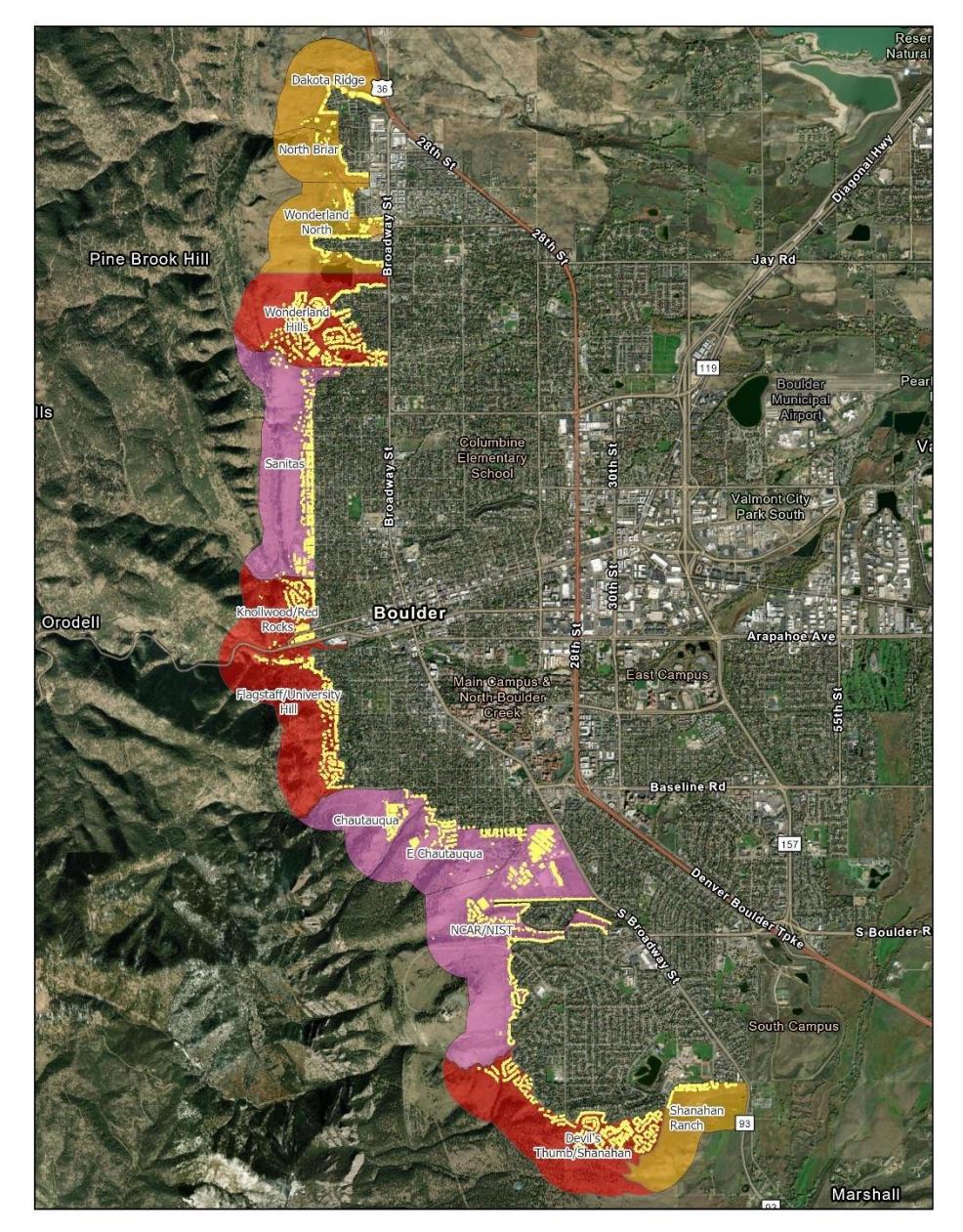
The framework gives the western wildland-urban interface a higher risk score than the eastern WUI — 5.4 compared with 3.4 — based on the likelihood of occurrence, potential fire intensity and exposure. Staff divided the western WUI into 12 sections and grouped them into Highest, Very High and High risk categories. The rest of the WUI, including areas east of Broadway, was classified as Moderate risk.
Those rankings are still draft. Staff said they could change before an Oct. 22 Council report as additional data and expert input are incorporated. The risk index is a planning and resource-allocation tool, not a prediction of where a wildfire will occur or a guarantee of outcomes.
Home-hardening hub is still in development
The proposed Home Hardening Implementation Hub would be a public web resource for property owners and renters. Planned materials include instructional videos, a mitigation-work cost estimator, projects organized by cost and time, insurance and neighbor-conversation guidance, incentives and links to state and regional resources.
As of Aug. 29, the city’s existing wildfire-resilience resources did not identify a separate live hub. The city’s Wildfire Resilience Assistance Program and Detailed Home Assessment services remain available, but the packet provides no firm launch date for the proposed all-in-one resource. Staff said community feedback opportunities, including a survey, website analytics and wildfire pop-up events, were planned for late 2026.
Staff is developing at least one measure for each Tier 1 program, with targets generally extending through 2030. A worked example would treat 100% of city-owned WUI natural-area acreage in all 12 priority sections by the end of 2030, subject to staffing and funding scenarios.
The city plans to publish annual progress tracking through its Wildfire Ready platform after the planned Oct. 22 Council presentation. The packet provides no completed dashboard, final measures or adopted targets, and does not establish how the Home Hardening Hub itself would be evaluated.
Reliability projects advance
The 75th Street undergrounding project is under construction between the city’s Water Resource Recovery Facility south of Jay Road and Lookout Road. Staff says it is intended to reduce outage and wildfire risk for Heatherwood, Country Club, city critical infrastructure and nearby communities.
The Highway 36 project is in permitting and final design with the Colorado Department of Transportation, with construction targeted to begin before the end of 2026. It would place about 5.5 miles of line underground from approximately Jay Road to Neva Road and along Neva Road. Staff describes the line as a high wildfire risk and says it has been included in all public-safety power shutoff events to date, producing extended outages in north Boulder, Niwot and Gunbarrel.
The Highway 93 project is also in permitting and final design with Boulder Open Space, Boulder County and CDOT. Its proposed route runs from east of the Eldorado Substation along Eldorado Springs Drive and Marshall Road, then south toward Golden. The team is evaluating Thomas Lane, though floodplain issues could make that segment infeasible. Staff says relatively few Boulder customers are served by the line.
Phase one of the 9216 rebuild, from Boulder Hydro to the Sunshine Canyon connection, is underway. Phase two is expected to begin construction in 2027, but the packet gives no completion date. The line is more than a century old and runs through high-wildfire-risk areas to the Sunshine and Boulder Terminal substations.
An Xcel transmission-project filing lists three 9216 work orders totaling about $20.4 million. The filing describes a teardown and rebuild, including a short underground section outside Boulder Terminal, but does not establish that the costs will be charged specifically to Boulder customers. Some transmission and wildfire-mitigation investments are recovered through systemwide mechanisms, including the Transmission Cost Adjustment.
Under Boulder’s Xcel partnership, Xcel committed $33 million to power-line undergrounding, with about half planned in the first five years. A separate partnership overview says 1% of Boulder’s gross electric revenue — estimated at about $1.1 million annually — is dedicated to city-directed undergrounding. It estimates that $15.5 million had been spent on overhead-to-underground conversions through 2025. Those figures do not show the cost of the three projects now in design or construction or their effect on individual bills.
The Colorado Public Utilities Commission approved a separate Xcel electric-revenue increase of about $157 million in August. The commission estimated that it would raise a typical residential bill by 4.77%, or about $5 per month, beginning Aug. 29. The decision does not attribute that increase to Boulder’s undergrounding, substation or 9216 work, so it is not a project-specific estimate.
2027 milestone has a clearer path than 2030 target
Staff considers the 2027 milestone achievable based on early-2026 emissions data and renewable resources expected to come online. A detailed Xcel 2027 emissions forecast was not completed in time for the council memo, however, and the packet says Xcel was expected to present its forecast to the council.
One cited resource is the 335-megawatt Arroyo solar project in Pueblo, which was expected to begin operating later in 2026. The packet does not quantify its contribution to Boulder’s franchise milestones.
The longer-term outlook is less certain. Electricity demand is growing while some replacement generation has been delayed or failed. Staff says those conditions could leave Xcel short of the resources needed to meet statewide demand in 2027 and part of 2028, and the packet warns that reliability problems could lead to load shedding, or rolling brownouts.
Xcel’s clean-energy-plan materials say Comanche 3 is to retire by Jan. 1, 2031, ending the company’s use of coal in Colorado. A later resource-plan proposal describes operating the plant through 2040 at a reduced capacity factor and adding about 600 megawatts of natural-gas resources for reliability. That proposal is not an approved retirement schedule and does not establish that an extension has been authorized.
Affordability and gas planning remain unresolved
Boulder staff identified affordability as a concern for lower-income households and customers who cannot afford the upfront cost of electrification. The packet provides no forecast for household bills resulting from the grid work, electrification or declining gas use.
Boulder was selected in 2025 as one of five gas-planning communities under House Bill 24-1370. The city and Xcel are reviewing the gas system for opportunities to avoid future investments and permanently retire portions of it. Staff says reducing gas-system spending as sales decline will be important; otherwise, customers who cannot electrify could face higher costs as fixed expenses are spread across fewer customers.
The partnership analysis models an 83.3% reduction in electricity emissions by 2030 against a 2018 baseline and assumes a 2030 electricity emissions factor of 0.1258 metric tons per megawatt-hour. Those are model results and assumptions, not proof that the 6.9-million-ton systemwide milestone will be met.
The Aug. 27 session was discussion-only; it produced no vote, appropriation or binding change in Xcel policy. The city plans a Power Reliability and Resilience Council/Community Forum on Oct. 8 and expects to continue working with Xcel on the unresolved emissions, reliability, affordability and wildfire-resilience questions.