
Xcel’s North 63rd redevelopment remains in concept review; no annexation application filed as of Aug. 4
Boulder staff said Xcel’s proposed 2655 N. 63rd Street redevelopment had not reached formal annexation or project approval after an Aug. 4 concept review, where board members requested design changes.
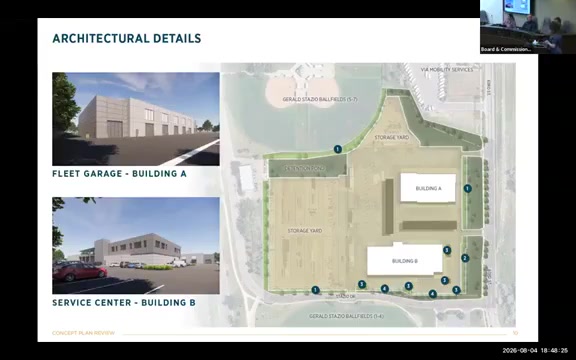
Xcel Energy’s proposed redevelopment of its operations center at 2655 N. 63rd Street remains in concept review, with no annexation application received as of an Aug. 4 Boulder Planning Board hearing.
The plan would replace the approximately 55,000-square-foot service center and 33,000-square-foot fleet garage in two phases while retaining the site’s industrial utility use. The roughly 14-acre property is a Boulder County enclave. The city’s Planning and Development Services calendar lists the meeting as a concept-plan public hearing under case LUR2026-00026.
Concept review did not produce a land-use decision. Staff told the board the proposal was neither approved nor denied. Before later reviews can proceed, the property would need annexation and initial city zoning, according to the Planning Board meeting record.
Staff described the next stages as annexation and initial zoning, followed by site review and use review. Annexation would require hearings before the Planning Board and City Council. Site review and use review generally would be decided administratively, subject to Planning Board call-up, unless a proposed height modification triggers a board hearing. The city’s land-use review guide treats those as separate stages after an application is submitted.
Board members generally viewed continued industrial use as compatible with the city’s comprehensive plan but asked Xcel to revisit employee open space and shade, pavement, landscaping and screening, fencing, and renewable-energy features such as rooftop or parking-canopy solar. They also encouraged the company and city staff to consider a non-housing community benefit tied to annexation.
Xcel said it was still considering solar canopies. The company proposed a 10-foot no-climb perimeter fence, compared with the city’s seven-foot standard; the board did not approve the fence or require the suggested redesigns. One person spoke against annexation and Xcel during the hearing, while staff reported no online speakers and no comments through the mailed-notice process.
No project-specific date for a subsequent annexation hearing or administrative review had been published in the city calendar through Aug. 7. If the project advances, Xcel said construction would take roughly 12 to 18 months after entitlements, permits and other approvals. Staff described a possible three-year period for each phase, but those timelines remain contingent on future applications and decisions.